
Choosing the right vehicle auxiliary power systems with DC DC charger can make overlanding, work travel, and off-grid camping far more reliable. The best setups balance charging speed, battery compatibility, and installation simplicity.
Below, we’ve focused on options that suit different use cases—from smart dual-battery systems to high-output alternator chargers for portable power stations and solar-ready onboard units.
Best 10 Vehicle Auxiliary Power Systems with DC DC Charger Picks for 2026
Smart Dual-Battery Charger

- 98.5% efficiency with 700W continuous output
- Configurable current limits for safer charging
- VictronConnect app with live data and history
Best For: Dual-battery vehicle builds with intelligent alternators
Portable Power Station Fast Charger

- 560W alternator charging for portable power stations
- Compatible with BLUETTI and many third-party units
- Automatic control helps prevent vehicle battery drain
Best For: Road trips and RV users charging portable power stations
Isolated Bluetooth Battery Charger
Victron Orion-Tr Smart 12/12V 18A

- Three-stage isolated charging for dual batteries
- Bluetooth monitoring with VictronConnect app
- Works with lead-acid or lithium batteries
Best For: Smaller dual-battery installs needing isolation
Smart Vehicle Power Charger
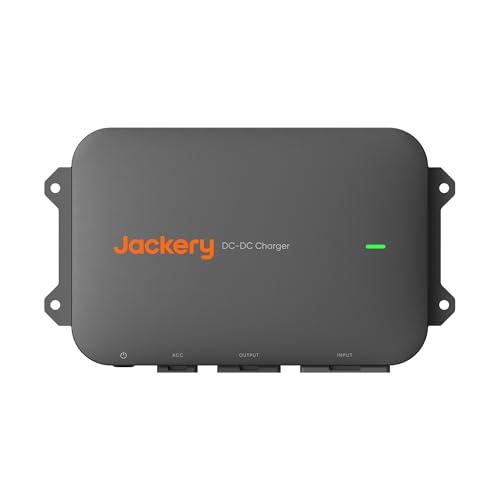
- 600W output for fast on-the-road charging
- Supports 12V and 24V vehicle systems
- Auto protection stops charging when parked
Best For: Jackery power station users needing fast vehicle charging
Rugged Solar-Ready Option
40A IP68 Waterproof DC to DC Charger with MPPT

- 40A charger with solar MPPT input
- IP68 waterproof for harsh environments
- Supports AGM, Gel, STD, and LiFePO4 batteries
Best For: Off-grid vehicle and marine setups that need solar and alternator charging
Isolated Bluetooth Choice
Victron Orion-Tr Smart 12/12V 30A Isolated

- 30A isolated DC-to-DC charger
- Bluetooth monitoring via VictronConnect
- Works with lead-acid and lithium batteries
Best For: Dual-battery systems that need isolation and app-based monitoring
Dual-Input 40A Solar Charger
12V 40A DC to DC Charger with MPPT
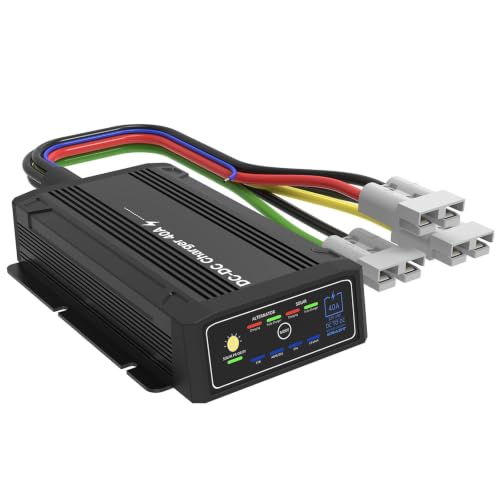
- Charges from alternator or solar input.
- MPPT support improves solar charging efficiency.
- 40A output suits larger auxiliary battery banks.
Best For: Off-grid and overlanding setups that use solar plus alternator charging.
High-Output Dual Input Charger
Power Queen 12V 40A DC to DC On-Board Charger
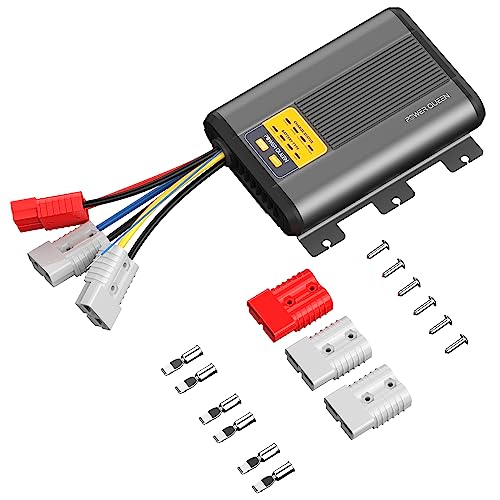
- Charges from generator and solar sources.
- MPPT boosts solar charging efficiency.
- Compact design with Anderson connectors saves space.
Best For: Compact 12V systems needing dual-input charging and lithium support.
Smart Dual-Battery Charger – Victron Orion XS 12/12V 50A
If you’re building vehicle auxiliary power systems with DC DC charger support, the Victron Orion XS is aimed at setups that need high output, high efficiency, and tight control. It’s designed for dual battery systems charged by intelligent alternators, with configurable input and output current limits to help match your vehicle and house battery setup.
Best For: Dual-battery vehicle and overland builds that need a fully configurable, high-efficiency charger for intelligent alternators.
Pros:
- 98.5% efficiency and a 700W continuous rated output
- Configurable current settings to protect alternators and batteries
- VictronConnect app support with real-time data and 30-day history
- IP65 dust- and water-resistant housing for tougher installs
Cons:
- Primarily built around 12V dual-battery charging rather than portable power stations
- May be more charger than needed for simpler, low-demand setups
The Orion XS stands out when you want a compact, efficient charger with detailed control and monitoring. For advanced vehicle auxiliary power systems with DC DC charger integration, it offers the kind of configurability and protection that makes a serious install easier to manage.
Portable Power Station Fast Charger – BLUETTI Charger 1 560W
For vehicle auxiliary power systems with DC DC charger use cases centered on portable power stations, the BLUETTI Charger 1 focuses on faster alternator charging on the road. It delivers up to 560W and is positioned as a much quicker option than a standard cigarette-lighter charger, with automatic control to help avoid draining the vehicle battery.
Best For: Road trips, RV travel, and portable power station owners who want faster alternator charging.
Pros:
- Up to 560W charging for much faster top-ups on the move
- Compatible with BLUETTI models and many third-party power stations
- Automatic charging control helps protect the vehicle battery
- Active cooling fan for better heat handling
Cons:
- Built around portable power stations rather than dual-battery house systems
- Uses a 24V DC input specification, so fitment should be checked carefully
This charger makes sense if your priority is faster in-vehicle charging for a portable power setup. Its universal compatibility and battery-protection logic give it broad appeal, especially for travelers who want a practical alternator-fed charging solution.
Isolated Bluetooth Battery Charger – Victron Orion-Tr Smart 12/12V 18A
If you’re comparing vehicle auxiliary power systems with DC DC charger options for a smaller dual-battery setup, the Victron Orion-Tr Smart offers a practical 18A, 220W solution. It uses a three-stage charging process, Bluetooth monitoring, and isolated design to support safe charging for vehicles or boats using the alternator and start battery.
Best For: Smaller dual-battery installs that need isolated charging with Bluetooth monitoring.
Pros:
- Three-stage charging for efficient and safe battery charging
- Built-in Bluetooth with VictronConnect app support
- Suitable for lead-acid and lithium batteries
- Multiple units can be connected in parallel for more output
Cons:
- Lower 18A output than higher-capacity DC-DC chargers
- Installation uses screw terminals, which may be less plug-and-play than some alternatives
This model is a good fit when you want Victron control and isolation in a more compact charger. It’s not the highest-power option here, but it offers flexible compatibility and expansion potential for smaller auxiliary power builds.
Smart Vehicle Power Charger – Jackery DC-DC 600W
For vehicle auxiliary power systems with DC DC charger needs centered on portable power stations, the Jackery DC-DC Charger provides a 600W solution for faster charging on the road. It supports 12V and 24V systems, includes automatic charging controls, and is designed to work directly with Jackery power stations through DC8020 ports.
Best For: Jackery power station owners who want fast in-vehicle charging with simple compatibility.
Pros:
- 600W output for faster charging than standard cigarette-lighter options
- Supports 11.8–32V input for both 12V and 24V systems
- Automatic charging stop when parked to reduce battery drain
- Direct DC8020 compatibility with Jackery power stations
Cons:
- Best suited to Jackery ecosystems rather than universal battery-bank installs
- No extra adapters needed, but that also narrows compatibility to the supported port style
This is a straightforward option if you already use Jackery gear and want a faster alternator-based charger. Its broad vehicle voltage support and smart protection features make it a convenient road-trip companion.
Premium Smart Pick – Victron Orion-Tr Smart 12/12V 30A Non-Isolated
If you’re comparing vehicle auxiliary power systems with DC DC charger support, this Victron Orion-Tr Smart is built for clean, controlled charging in dual-battery setups. It uses a three-stage charging process, works with lead-acid and lithium batteries, and adds Bluetooth control through the VictronConnect app for easy monitoring on the go.
Best For: Drivers and boat owners who want a smart, app-enabled 12V dual-battery charger with flexible expandability.
Pros:
- 30A, 360W DC-to-DC charging with a three-stage process
- Bluetooth monitoring and adjustments through VictronConnect
- Compatible with lead-acid and lithium batteries
- Multiple units can be connected in parallel to increase output
Cons:
- Non-isolated design may not suit every system layout
- Only supports 12V input and 12V output configurations
- No solar input or MPPT feature
This is a strong choice if you want a professional-grade charger for a vehicle auxiliary power system and value app-based visibility. Its biggest strengths are smart control, battery flexibility, and the ability to scale output with additional units.
Rugged Solar-Ready Option – 40A IP68 Waterproof DC to DC Charger with MPPT
For vehicle auxiliary power systems with DC DC charger support in harsher conditions, this 40A unit stands out with IP68 waterproofing and dual-input charging. It can charge from the engine while driving or pull directly from solar through its built-in MPPT, making it a practical fit for campers, trailers, boats, and other mobile setups.
Best For: Off-grid builds that need waterproof protection and the flexibility of solar plus alternator charging.
Pros:
- 40A DC-to-DC charging for 12V systems
- Built-in MPPT for direct solar charging
- IP68 waterproof rating for tougher environments
- Supports AGM, Gel, STD, and LiFePO4 batteries
Cons:
- Less established brand presence than premium rivals
- Control interface relies on LED indicators and buttons
- Warranty coverage is limited to a 30-day free return period
Overall, this charger makes sense when durability and charging flexibility matter more than advanced app features. The combination of MPPT solar support, alternator input, and protective features gives it broad usefulness for mobile power installs.
Isolated Bluetooth Choice – Victron Orion-Tr Smart 12/12V 30A Isolated
If your vehicle auxiliary power system with DC DC charger needs galvanic separation, this Victron Orion-Tr Smart isolated model is the more installation-friendly option for certain dual-battery layouts. It delivers the same 30A, 360W three-stage charging and Bluetooth monitoring as the non-isolated version, but with isolated output for added system separation.
Best For: Dual-battery installs that benefit from isolated charging and Victron’s Bluetooth monitoring.
Pros:
- 30A, 360W output with three-stage charging
- Isolated design for system separation
- Bluetooth support with the VictronConnect app
- Compatible with lead-acid and lithium batteries
Cons:
- Does not include solar MPPT input
- Only 12V to 12V charging
- Higher complexity than a basic charger if isolation isn’t needed
This model is best when isolation is a specific requirement rather than a nice-to-have. If you want proven Victron monitoring and battery compatibility in a separated dual-battery setup, it is a very solid fit.
Compact Multi-Stage 20A Charger – VEVOR 12V 20A DC to DC Battery Charger
If you need vehicle auxiliary power systems with DC DC charger support for RVs, trucks, boats, or yachts, this VEVOR unit is a straightforward 12V 20A option. It handles lead-acid and lithium batteries, includes multi-stage charging, and adds protection features that help it fit into everyday on-board charging setups.
Best For: Smaller auxiliary battery systems that need a compact, versatile DC-to-DC charger for mixed battery types.
Pros:
- Compatible with lead-acid, lithium, AGM, gel, and flooded batteries.
- Smart multi-stage charging includes 2-stage LiFePO4 and 3-stage lead-acid profiles.
- Built-in over/under voltage, high temperature, and reverse polarity protection.
- Compact aluminum alloy housing with pre-drilled mounting holes for easier installation.
Cons:
- 20A output is better suited to lighter charging needs than higher-demand systems.
- No dual solar input or MPPT capability is listed.
- Designed for 12V systems only.
Overall, this is a practical choice if you want a simple DC-to-DC charger with broad battery compatibility and basic protection in a compact form. Its feature set is well aligned with smaller auxiliary charging installs where space and straightforward operation matter.
Dual-Input 40A Solar Charger – 12V 40A DC to DC Charger with MPPT
For vehicle auxiliary power systems with DC DC charger requirements, this 12V 40A model stands out for its dual-input design. It can charge from the alternator or solar panels, and the built-in MPPT function helps prioritize solar charging when you want to make better use of panel power.
Best For: Users who want a higher-output auxiliary charger with both alternator and solar input options.
Pros:
- Dual-input charging supports batteries or solar panels.
- Built-in MPPT technology helps maximize solar charging efficiency.
- 40A output is a strong fit for larger 12V auxiliary battery systems.
- Includes LED indicators, mode selection button, and clear charging status feedback.
Cons:
- Requires selecting the correct alternator or solar mode for operation.
- Uses an Anderson plug connection, which may not suit every install.
- Designed for common 12V batteries only.
This charger is a good match if you want more flexibility than a standard alternator-only unit. The combination of dual input, MPPT support, and broad battery compatibility makes it appealing for vehicles and builds that also rely on solar.
High-Output Dual Input Charger – Power Queen 12V 40A DC to DC On-Board Charger
If you are comparing vehicle auxiliary power systems with DC DC charger capability, this Power Queen 40A unit is built for flexible service battery charging. It supports generator and solar input, adds MPPT for better solar use, and keeps the form factor compact enough for tighter vehicle installs.
Best For: Buyers who want a compact 40A charger with dual-input charging and broad battery compatibility.
Pros:
- Supports charging from both generator and solar panels.
- Built-in MPPT helps maximize solar power at the proper voltage and phase.
- Compatible with lithium, AGM, gel, SLA, and CA batteries.
- Compact size and Anderson connectors simplify setup and save space.
Cons:
- Input voltage listing is specific, so setup should be checked carefully.
- No detailed waterproof rating is provided in the notes.
- Best suited to 12V service battery systems rather than broader voltage needs.
This model makes sense if you want a compact, feature-rich charger with a strong mix of compatibility and solar support. The reverse charge function and BMS protection add helpful safety support for lithium-focused builds.
How We Picked These Vehicle Auxiliary Power Systems with DC DC Charger
We prioritized real-world usefulness: charging output, support for common battery chemistries, smart features, and whether the unit fits a dual-battery, portable power station, or solar-assisted setup. We also looked at waterproofing, isolation/non-isolation options, and install flexibility.
Quick Comparison: What Matters Most
Higher amperage usually means faster charging, but only if your alternator, wiring, and battery bank can support it. Bluetooth/app control can simplify tuning and monitoring, while MPPT solar input matters if you want one system to handle both alternator and solar charging.
Key Buying Factors for Vehicle Auxiliary Power Systems with DC DC Charger
Battery Compatibility
Check that the charger supports your battery type, especially lithium, AGM, gel, SLA, flooded, or lead-acid. Some models are more configurable than others, which is important if your vehicle and house battery differ.
Output and Charging Speed
Choose output based on your electrical demands and driving habits. Lower-output units are fine for maintenance or smaller auxiliary batteries; 30A to 50A models are better for frequent use, larger banks, or faster recharge windows.
Isolation Vs. Non-Isolation
Isolated chargers help separate circuits and reduce electrical noise between batteries. Non-isolated models can be more efficient or simpler for certain layouts, so match the design to your vehicle and system architecture.
Solar and Environmental Protection
If you camp or work outdoors, IP-rated waterproof units and dual-input models with MPPT add versatility and durability. This is especially useful when you want one charger to manage alternator and solar input without extra hardware.
Who Should Buy Which Vehicle Auxiliary Power Systems with DC DC Charger?
If you want a premium, highly configurable dual-battery setup, a smart Victron-style charger is a strong fit. If your priority is fast charging for a portable power station, a high-wattage alternator charger may be the better choice. If you need a rugged all-in-one option for mixed solar and vehicle charging, look for a waterproof DC-DC charger with MPPT and dual inputs.
For lighter-duty or budget-conscious builds, a 20A class charger may be enough. For expedition rigs, work trucks, and higher-capacity lithium systems, 40A to 50A models usually offer the best balance of speed and practicality.