
Accurate camber readings can make a big difference in tire wear, handling, and repeatable suspension setup. Whether you’re working on a daily driver, track car, or RC build, the right digital camber gauge helps you measure faster and adjust with confidence.
This roundup highlights the best options for different needs, from simple magnetic-base tools to advanced alignment gauges with added angle functions and Bluetooth features.
Best 9 Digital Camber Gauges Picks for 2026
Best for Accuracy
Longacre Digital Caster Camber Gauge

- 0.1° digital precision for camber and caster
- Backlit display for low-light use
- Magnetic adapter plus padded hard case
Best For: Racers and DIY alignment users who need precise, repeatable camber and caster readings.
Best for Conduit Bending
Klein Tools 935DAG Digital Angle Gauge

- 0-90 and 0-180 degree ranges for versatile angle measuring
- Magnetic base and V-groove edges improve hands-free alignment
- Auto-rotating reverse display is easy to read in awkward positions
Best For: Electricians and DIYers who need a magnetic angle gauge for conduit and leveling tasks.
Best for Large Wheels
Longacre Digital Caster/Camber Gauge

- 0.1° digital camber and caster readings
- Quick-set adapter fits 13" to 24" aluminum wheels
- Removable AccuLevel display and hard case included
Best For: Drivers and racers who need accurate alignment readings on larger wheels.
Best for Repeatable Angle Checks
GemRed 82412 Digital Angle Gauge

- 0.1° resolution with ±0.2° stated accuracy
- Durable aluminum frame for shop use
- Easy mode switching for level and relative angles
Best For: Woodworkers, mechanics, and DIY users who need a rugged angle gauge for repeatable measurements.
Best for Wide-Range Checks

- Digital LCD with backlight for quick readings
- -90° to +90° range fits cars, trucks, vans, and bikes
- Magnetic base, bubble level, and zero reset improve setup
Best For: DIY alignment checks and basic suspension camber adjustments on a budget.
Best for 1/8 RC Setup
SKYRC CTG-016 Digital Camber Gauge

- Built for 1/8 RC car camber and toe setup
- Bluetooth 5.0 app support for easier readings
- USB-C rechargeable with compact aluminum body
Best For: 1/8 scale RC racers who want app-connected setup measurements.
Best for Magnetic Setup
Klein Tools Digital Angle Gauge

- Magnetic base supports hands-free use on metal surfaces
- Converts between degrees, percent grade, mm/m, and in/ft
- Auto-rotating display improves readability in tight spots
Best For: Tradespeople and DIY users who need a versatile magnetic angle gauge for slopes, pipes, and metal surfaces.
Best for Bluetooth Setup
SKYRC CTG-015 Digital Camber Gauge
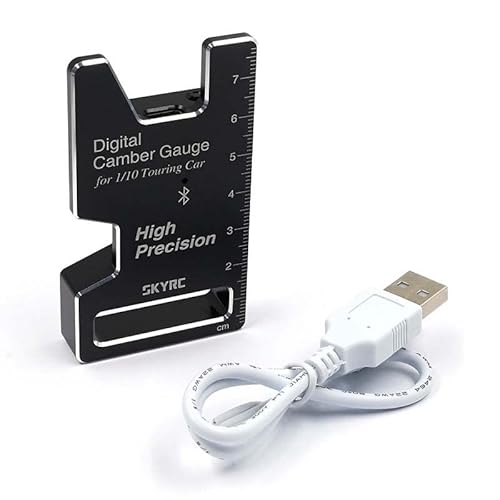
- Bluetooth 5.0 with live app readings
- Measures camber and toe in one tool
- Compact body with USB-C charging
Best For: RC racers who want a compact, app-connected camber and toe setup tool.
Best for Magnetic Mounting
Digital Camber Gauge with LCD Display

- Strong magnetic base for secure attachment to brake discs
- LCD backlight improves visibility in low-light garages
- Zero reset and data hold simplify repeat measurements
Best For: DIY alignment work where secure mounting and easy digital readings matter.
Best for Accuracy – Longacre Digital Caster Camber Gauge
If you want a precise alignment tool for your garage or track setup, this Longacre unit is a strong fit among digital camber gauges. It reads to 0.1° for both camber and caster, includes a magnetic adapter for easier positioning, and uses a backlit display so you can work in dim shop lighting.
Best For: Racers and serious DIY owners who want accurate front-end alignment checks and repeatable camber/caster adjustments.
Pros:
- Reads to 0.1° for very fine alignment adjustments
- Backlit digital display helps in low-light areas
- Magnetic adapter and hard case improve portability and protection
- Rugged billet aluminum construction
Cons:
- More specialized than basic alignment tools
- Higher price than entry-level camber gauges
- Primarily aimed at users who need precision, not casual checking
Overall, this is a well-built choice for drivers who care about exact setup and tire wear. Among digital camber gauges, it stands out for its combination of accuracy, durability, and track-friendly features.
Best for Conduit Bending – Klein Tools 935DAG Digital Angle Gauge
If you need one of the more practical digital camber gauges for angled work, the Klein Tools 935DAG is built for fast setup, clear readings, and hands-free use on metal surfaces. It combines a wide angle range with a magnetic base, making it especially useful for conduit, saw blades, vents, and other alignment tasks where accuracy matters.
Best For: Electricians, tradespeople, and DIYers who need a magnetic angle gauge for conduit bending and quick leveling.
Pros:
- Measures both 0-90 and 0-180 degrees for flexible angle setup
- Strong magnetic base and V-groove edges help it stay aligned on conduit and pipe
- Reverse contrast display auto-rotates for easier reading in tight or dark spaces
- Includes batteries and a carrying case, so it is ready to use out of the box
Cons:
- Not a dedicated automotive camber tool, so it is more of a general angle gauge
- IP42 resistance is helpful, but not fully weatherproof for harsh jobsite exposure
- Best performance depends on having a ferromagnetic surface to attach to
For buyers comparing digital camber gauges, this Klein model stands out as a rugged, jobsite-friendly angle gauge with excellent usability for bending and setting angles. It is less specialized than a true alignment tool, but for general measuring and conduit work, it offers a strong mix of precision and convenience.
Best for Large Wheels – Longacre Digital Caster/Camber Gauge
If you want a precise setup tool for track days or serious alignment work, this Longacre unit stands out among digital camber gauges. It reads to 0.1° for camber and caster, and the removable digital level makes it useful for more than just one job.
Best For: Drivers, racers, and home alignment setups that need accurate camber and caster readings on larger wheels.
Pros:
- Reads camber and caster to 0.1° for confident alignment adjustments
- Includes a quick-set adapter for 13″ to 24″ aluminum wheels
- AccuLevel display can be removed for other angle-measurement tasks
- Billet aluminum construction and hard case add durability
Cons:
- More tool than casual drivers typically need
- Higher-priced than basic camber-only gauges
For buyers comparing digital camber gauges, this Longacre model is a strong pick if wheel size range and repeatable accuracy matter most. It is especially appealing for enthusiasts who want one durable tool for alignment checks and related angle measurements.
Best for Repeatable Angle Checks – GemRed 82412 Digital Angle Gauge
If you need one of the more dependable digital camber gauges for quick setup work, the GemRed 82412 is a straightforward pick. It combines a 0.1° resolution with ±0.2° accuracy, a 0 to 360° range, and a bright green backlight that makes readings easier to see in dim shops or under vehicles.
Best For: Woodworkers, mechanics, and DIY users who want a durable angle gauge for repeatable leveling and angle comparisons.
Pros:
- 0.1° resolution with stated ±0.2° accuracy for fine adjustments
- Strong aluminum alloy frame should hold up better than plastic alternatives
- Two useful modes: true level and relative angle measurement
- Auto-reverse display and error indicator help reduce reading mistakes
Cons:
- Angle-only display may be limiting if you want more advanced measurements
- Not a dedicated automotive camber tool with vehicle-specific features
For buyers comparing digital camber gauges, this GemRed stands out more for repeatability and rugged construction than for specialty auto alignment features. It’s a practical choice when you want a simple, reliable angle gauge that can handle workshop and general-purpose measuring tasks.
Best for Wide-Range Checks – KAISAL Digital Camber Gauge
If you want a straightforward tool for checking wheel tilt, this KAISAL option is a practical fit among digital camber gauges. It combines a digital readout, a wide -90° to +90° measuring range, and a magnetic base so you can measure camber on brakes discs or other magnetic surfaces without a complicated setup.
Best For: DIYers and home mechanics who want an affordable, easy-to-read camber gauge for routine alignment checks and suspension work.
Pros:
- Clear digital LCD with backlight makes readings easy to see
- Wide -90° to +90° range suits many vehicle types
- Strong magnet and positioning bubble help improve setup accuracy
- Reset key is handy for zeroing after suspension adjustments
Cons:
- Magnetic mounting only works on suitable metal surfaces
- Not as feature-rich as higher-end professional alignment tools
Overall, this is a solid pick if you need digital camber gauges for occasional alignment checks, camber correction, or basic wheel balancing tasks. The aluminum build and simple controls make it accessible, while the range and display keep it useful for a wide variety of vehicles.
Best for 1/8 RC Setup – SKYRC CTG-016 Digital Camber Gauge
If you need digital camber gauges for a 1/8 RC car, the SKYRC CTG-016 is built for setup work rather than general shop use. It measures camber and toe angle, pairs with the RC Gears app over Bluetooth 5.0, and gives you a practical way to confirm changes before you hit the track.
Best For: 1/8 scale RC racers and hobbyists who want app-connected camber and toe measurements for repeatable suspension setup.
Pros:
- Designed specifically for 1/8 RC cars, not the smaller 1/10 version
- Bluetooth 5.0 app support makes readings easier to view during setup
- Rated to +/-0.2-degree accuracy with a +/-17.5-degree measuring range
- USB-C rechargeable with a compact aluminum body for pit-bag portability
Cons:
- Limited to 1/8 scale use, so it is not the right fit for all RC classes
- Requires the app and phone connection to get the most out of the gauge
For racers who want digital camber gauges that make suspension adjustments quicker and more consistent, the CTG-016 is a solid trackside tool. Its app connectivity and scale-specific sizing are the main reasons to choose it over simpler handheld gauges.
Best for Magnetic Setup – Klein Tools Digital Angle Gauge
If you need one of the more practical digital camber gauges for jobsite measuring, the Klein Tools 935DGGP is built around fast setup and clear readings. It converts between degrees, percent grade, mm/m, and in/ft, so it works well for framing, slope checks, tiling, and pipe alignment without extra math.
Best For: Tradespeople and DIY users who want a magnetic digital gauge for angle finding, leveling, and slope work on metal surfaces.
Pros:
- Strong magnetic base helps with hands-free use on pipes, ducts, saw blades, and other ferromagnetic surfaces
- Supports multiple unit conversions for flexible measuring on different types of jobs
- Auto-rotating, high-contrast display is easier to read in awkward or dim locations
- V-groove edges improve alignment on conduits and round stock
Cons:
- Best performance depends on working with metal surfaces for magnetic attachment
- IP42 rating offers some protection, but it is not fully weatherproof
- More specialized than a basic bubble level for casual home use
For buyers comparing digital camber gauges by utility rather than auto-focused features, this Klein model stands out for its magnetic hold, readable display, and versatile angle conversion. It is a solid pick when accuracy and easy positioning matter more than a simple one-function gauge.
Best for Bluetooth Setup – SKYRC CTG-015 Digital Camber Gauge
For RC tuners who want faster suspension checks, one of the most practical digital camber gauges is the SKYRC CTG-015. It measures camber and toe, then sends live readings to your phone over Bluetooth 5.0, making it easier to dial in 1/10 touring car settings without constant back-and-forth adjustments.
Best For: RC racers and hobbyists who want a compact, app-connected setup tool for quick camber and toe tuning.
Pros:
- Bluetooth 5.0 connection with real-time app display
- Measures both camber and toe in one compact tool
- Very small, portable design with USB-C charging
- High stated accuracy at ±0.2°
Cons:
- Designed mainly for 1/10 RC touring cars
- Requires a phone/app workflow to get the most out of it
- More feature-rich than basic standalone gauges, so not the cheapest option
The CTG-015 stands out if you want digital camber gauges that feel more modern and efficient than traditional analog tools. Its app-based live readings, small size, and toe-measuring support make it a strong choice for racers who care about fast, repeatable setup work.
Best for Magnetic Mounting – Digital Camber Gauge with LCD Display
If you need one of the more practical digital camber gauges for home garage use, this model stands out for its magnetic base, clear LCD readout, and simple zero-reset workflow. It’s designed for measuring camber and caster on wheels or brake discs, making it useful after suspension changes or when dialing in alignment adjustments.
Best For: DIY mechanics and small shops that want a straightforward alignment tool with magnetic mounting and easy digital readings.
Pros:
- Magnetic base helps it attach securely to brake discs and other metal surfaces
- Digital LCD with backlight is easy to read in dim garages
- Zero reset and data hold make repeated alignment checks simpler
- Wide -90° to +90° range covers common camber and caster adjustments
Cons:
- Best suited to alignment tasks rather than full professional shop workflows
- Requires careful setup to get the most accurate readings
Overall, this is a solid fit if you want digital camber gauges that are easy to mount, easy to read, and built for repeatable suspension tuning. It balances convenience and accuracy well for routine wheel alignment work.
How We Picked These Digital Camber Gauges
We focused on accuracy, ease of calibration, display readability, magnetic strength, measurement range, build quality, and overall value. We also looked at whether each tool is better suited for general vehicle alignment, suspension tuning, or RC car setup. The best Digital Camber Gauges should be easy to zero, stable on the wheel or hub, and clear enough to read in a garage or shop.
Quick Comparison
Before buying, decide how you’ll use the tool. A dedicated camber gauge is usually best for wheel alignment work, while multi-function angle gauges are more versatile for shop tasks. RC-specific models make sense if you need fine adjustments on smaller vehicles, and combo tools can be a good value if you want camber plus caster or level functions in one device.
Key Buying Factors for Digital Camber Gauges
Measurement Range and Precision
Check that the gauge covers the angles you actually need. Most passenger-car alignment work falls within a modest camber range, but a wider span can help with lowered vehicles, lifted trucks, or specialized setups. Precision and repeatability matter more than flashy features.
Mounting Method
Magnetic bases are convenient on steel hubs and brake components, while some tools rely on adapters or direct wheel contact. Make sure the attachment style matches your vehicle and won’t interfere with your workflow.
Calibration and Zeroing
A good gauge should be simple to calibrate and hold its zero. If you’ll use it often, fast setup can save time and reduce measurement errors.
Display and Readability
Look for a clear LCD, backlight if you work in dim spaces, and stable readings that don’t bounce around. For shop use, quick readability is a real advantage.
Durability and Power
Since alignment tools get handled frequently, a solid housing and dependable battery life are important. If you move between jobs often, compact size and easy storage also matter.
Who Should Buy Which Digital Camber Gauges?
If you want a dedicated alignment tool for cars, trucks, or SUVs, choose one of the more specialized Digital Camber Gauges with a strong mounting base and a practical range. If you need a multi-purpose shop tool, a digital angle gauge may be the better fit. RC enthusiasts should prioritize compact, purpose-built models designed for small suspension adjustments. For buyers who want one tool for multiple tasks, combo gauges with caster, camber, and level functions offer the most flexibility.
In short, the best choice depends on whether you value accuracy, versatility, or convenience most. Focus on the features that match your vehicle and how often you’ll use the gauge.