
Choosing the right meter can save time, reduce guesswork, and help you diagnose ignition, sensor, and charging issues with confidence.
These 10 picks focus on automotive multimeters with duty cycle support, giving you the features that matter most for practical garage and roadside testing in 2026.
Best 10 Automotive Multimeters with Duty Cycle Picks for 2026
Premium Diagnostic Pick
Fluke 88V for Conventional and Hybrid Vehicles

- Pulse width and duty cycle measurement
- 10 meg ohm input impedance
- Min/Max/Avg recording with bright backlight
Best For: Technicians needing a rugged meter for advanced automotive diagnostics
Budget-Friendly Feature Pack
Auto-Ranging Multimeter with Duty Cycle

- Auto-ranging with True RMS and 6000 counts
- Measures duty cycle, temp, capacitance, and continuity
- Includes NCV and backlit LCD
Best For: DIYers who want a versatile, easy-to-use meter
Automotive-Specific Value Pick
OTC 3980 750 Series Automotive Multimeter

- Duty cycle, frequency, diode, and continuity
- Adds RPM, dwell, pulse width, and temp
- Includes PC cable, software, and case
Best For: Mechanics needing vehicle-specific measurements in one meter
Versatile All-Around Choice
AstroAI TRMS Multimeter with Duty Cycle

- TRMS 6000-count meter with auto-ranging
- Measures duty cycle, frequency, and temperature
- Backlit display with data hold and kickstand
Best For: DIY mechanics wanting one versatile meter for many tests
Simple ignition-focused tester
ALLOSUN EM127 with RPM and Duty Cycle

- RPM, dwell angle, and duty cycle support
- Includes temperature plus core meter functions
- 1999-count LCD with auto power off
Best For: DIY automotive ignition and basic engine testing
Versatile everyday tester
KAIWEETS HT118A Auto-Ranging Duty-Cycle Meter
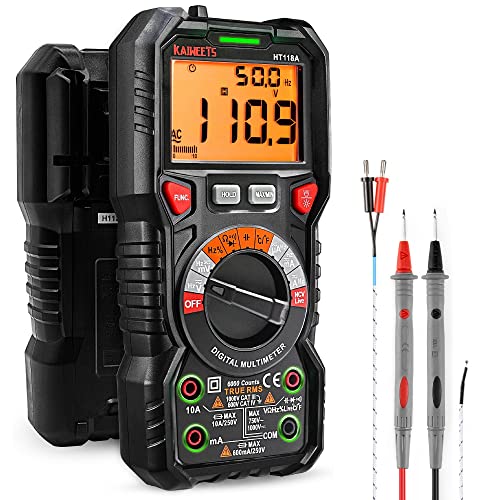
- 6000-count auto-ranging display
- Duty-cycle, capacitance, frequency, and temperature
- Non-contact voltage with CAT III/CAT IV ratings
Best For: DIYers needing one versatile meter for cars and general electrical work
Advanced garage diagnostic meter
DT151Q True RMS Automotive Multimeter with RPM

- True RMS with CAT III 600V safety
- RPM tracking for 4-8 cylinder engines
- Duty cycle, temp, capacitance, and frequency
Best For: Mechanics needing a higher-end automotive diagnostic multimeter
Garage-Ready All-Rounder

- Duty cycle plus AC/DC voltage, current, resistance, capacitance, and frequency
- 6000-count display with backlight and NCV/live wire testing
- CAT III 600V rating with built-in fuses and insulated holster
Best For: DIYers who want a versatile meter for car and household troubleshooting
Automotive Engine Tester

- Duty cycle plus 500-10000 RPM tachometer and dwell angle
- 1999-count display with overload protection
- Rugged shockproof case with built-in stand
Best For: Mechanics needing a car-focused tester with tach and dwell features
Feature-Packed Rechargeable Pick
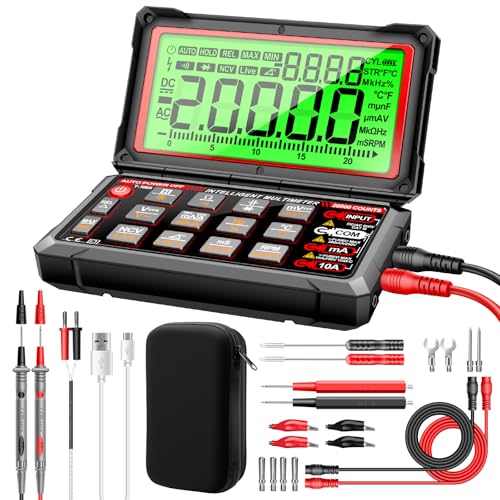
- Duty cycle plus RPM, dwell angle, and pulse-width testing
- 20,000-count backlit flip LCD with rechargeable power
- Double fuse protection and impact-resistant ABS housing
Best For: Frequent users who want a rechargeable automotive meter with advanced diagnostics
Premium Diagnostic Pick – Fluke 88V for Conventional and Hybrid Vehicles
If you want an automotive multimeter with duty cycle measurement for serious diagnostics, the Fluke 88V is built for conventional and hybrid vehicles. It combines pulse width, duty cycle, and Min/Max/Avg recording with a 10 meg ohm input impedance, helping you troubleshoot without risking damage to sensitive computer circuits.
Best For: Technicians who need a rugged, high-accuracy automotive meter for advanced vehicle troubleshooting.
Pros:
- Measures pulse width and duty cycle for automotive signal checks
- 10 meg ohm input impedance helps protect computer circuits
- Large display and bright backlight improve visibility
- Min/Max/Avg recording supports deeper troubleshooting
Cons:
- Premium tool may be more than casual users need
- Battery-powered design means ongoing battery management
This is the most purpose-built option here for demanding automotive work, especially when you need both signal measurement and vehicle-safe input protection. It stands out as a strong choice for hybrid-capable diagnostics and everyday shop use.
Budget-Friendly Feature Pack – Auto-Ranging Multimeter with Duty Cycle
This automotive multimeter with duty cycle support gives DIYers a broad feature set at a practical level. It includes auto-ranging, True RMS, and non-contact voltage testing, plus temperature, capacitance, continuity, and diode checks for everyday electrical work in cars and around the home.
Best For: DIYers and handymen who want an easy-to-use multimeter with lots of general test functions.
Pros:
- Auto-ranging makes setup simpler
- True RMS and 6000 counts improve reading quality
- Includes duty cycle, temperature, capacitance, and continuity
- Non-contact voltage testing adds convenience and safety
Cons:
- More general-purpose than automotive-specialized
- Not as focused on advanced vehicle diagnostics as dedicated shop models
For users who want a versatile tester rather than a niche automotive meter, this model covers a lot of ground. Its mix of safety features and everyday measurement modes makes it a flexible starter choice.
Automotive-Specific Value Pick – OTC 3980 750 Series Automotive Multimeter
For shoppers comparing automotive multimeters with duty cycle measurement, the OTC 3980 stands out because it adds vehicle-specific functions beyond the basics. Along with frequency, duty cycle, diode, and continuity tests, it also includes RPM, dwell, pulse width, and temperature for more targeted automotive troubleshooting.
Best For: Mechanics who want automotive-focused test functions in one portable meter.
Pros:
- Includes duty cycle plus pulse width, RPM, and dwell
- True RMS and Min/Max support troubleshooting
- Backlight and auto power off improve usability
- PC cable, software, and canvas case are included
Cons:
- Less general-purpose than some auto-ranging multimeters
- Battery-powered design may require occasional replacement
This is a strong fit if your work centers on automotive testing rather than broad household electrical use. The included vehicle-specific measurements make it especially useful when duty cycle alone is not enough.
Versatile All-Around Choice – AstroAI TRMS Multimeter with Duty Cycle
The AstroAI TRMS 6000 is a practical automotive multimeter with duty cycle measurement for users who want broad test coverage. It handles AC/DC current and voltage, resistance, capacitance, frequency, continuity, diode, temperature, and duty cycle, making it useful for automotive and household troubleshooting.
Best For: Home mechanics and DIY users who want a versatile meter with automotive-friendly functions.
Pros:
- Measures duty cycle along with frequency, capacitance, and temperature
- Auto-ranging and True RMS simplify and improve readings
- Backlit LCD, data hold, and kickstand improve usability
- Double ceramic fuse protection adds safety
Cons:
- Less specialized than dedicated automotive diagnostic meters
- Not aimed at advanced hybrid-specific troubleshooting
This model offers a good balance of features and ease of use, especially if you need one meter for multiple types of testing. It is a sensible pick when versatility matters as much as duty cycle measurement.
Simple ignition-focused tester – ALLOSUN EM127 with RPM and Duty Cycle
If you want automotive multimeters with duty cycle support for ignition and engine checks, the ALLOSUN EM127 is built around car-specific testing rather than general electrical use alone. It adds RPM, dwell angle, duty cycle, and temperature functions to the usual voltage, current, resistance, diode, continuity, and frequency measurements, making it a focused choice for basic garage diagnostics.
Best For: Drivers and DIY users who want a compact automotive tester with ignition and duty cycle functions.
Pros:
- Includes RPM, dwell angle, and duty cycle measurement for ignition system testing.
- Also covers DC voltage, DC current, resistance, diode, continuity, frequency, and temperature.
- 3 1/2-digit LCD with 1999 max reading keeps operation straightforward.
- Auto power off helps conserve battery life during shop or indoor use.
Cons:
- Notes suggest indoor use, and the LED display may be hard to read in sunlight.
- More basic 1999-count display than higher-resolution automotive meters.
- Best suited to general automotive testing rather than advanced professional diagnostics.
This is a practical pick if your priority is a simple automotive meter with the right extra functions for ignition work. It stands out most for combining duty cycle and dwell testing in a compact, battery-powered unit.
Versatile everyday tester – KAIWEETS HT118A Auto-Ranging Duty-Cycle Meter
For buyers comparing automotive multimeters with duty cycle, the KAIWEETS HT118A offers a broad set of test functions in an easy-to-use auto-ranging design. It measures voltage, current, resistance, temperature, capacitance, frequency, duty-cycle, continuity, and diodes, with added non-contact voltage and live-wire alerts for general electrical work around vehicles.
Best For: Home mechanics and DIY users who want a versatile multimeter for vehicles and everyday electrical testing.
Pros:
- Auto-ranging 6000-count display makes readings easier to take quickly.
- Includes duty-cycle, frequency, capacitance, temperature, and diode testing.
- Non-contact voltage and live function add convenience and safety cues.
- CAT III 1000V / CAT IV 600V ratings and double ceramic fuse protection.
Cons:
- Not as automotive-specialized as models that include RPM and dwell angle.
- Maximum current rating is 10A AC/DC, so it may not suit heavier tasks.
- Some features are more general-purpose than car-diagnostics specific.
The HT118A is a strong all-around choice if you want one meter that can handle car-related checks and broader household or workshop work. Its duty-cycle feature is a useful bonus, but its real strength is the balanced mix of functions and user-friendly design.
Advanced garage diagnostic meter – DT151Q True RMS Automotive Multimeter with RPM
If you need automotive multimeters with duty cycle plus more advanced engine-oriented features, the DT151Q is aimed at mechanics who want broader diagnostic coverage. It combines True RMS measurement, CAT III 600V safety, RPM tracking for 4-8 cylinder engines, and duty cycle testing with resistance, capacitance, temperature, and frequency functions.
Best For: Mechanics, serious DIYers, and EV or hybrid users who need a more capable automotive diagnostic meter.
Pros:
- True RMS and CAT III 600V rating support more demanding testing environments.
- Includes RPM tracking for 4-8 cylinder engines and duty cycle measurement.
- Wide measurement range covers voltage, current, resistance, capacitance, temperature, and frequency.
- Backlit LCD and data hold improve usability in dark garages and workshop settings.
Cons:
- Larger and heavier than simpler automotive meters.
- More feature-rich than needed if you only want basic voltage and continuity checks.
- Its advanced capabilities may be overkill for occasional casual use.
The DT151Q is the most capable option here for users who want a true automotive-focused meter with duty cycle and engine RPM support. It is especially appealing if you value safety rating, screen visibility, and a wider diagnostic feature set in one tool.
Garage-Ready All-Rounder – Crenova MS8233D
If you want automotive multimeters with duty cycle support that can still handle everyday electrical work, the Crenova MS8233D is a practical all-round pick. It measures voltage, current, resistance, capacitance, frequency, duty cycle, continuity, diode, NCV, and live wire, making it useful for a wide range of troubleshooting jobs in the garage or around the house.
Best For: DIYers and home mechanics who want one affordable multimeter for basic car diagnostics and general electrical testing.
Pros:
- Measures duty cycle plus AC/DC voltage, current, resistance, capacitance, frequency, continuity, diode, NCV, and live wire.
- 6000-count LCD with backlight helps when readings need to be clear in darker spaces.
- IEC61010-1 CAT III 600V rated with built-in fuses and an insulated rubber holster for protection.
- Includes test leads, alligator clips, batteries, and a carrying box.
Cons:
- Not an engine analyzer, so it lacks dedicated RPM or dwell angle functions.
- Sampling speed is listed at 3 times per second, which is fairly basic for fast-changing signals.
- Designed for broad troubleshooting rather than advanced automotive-only diagnostics.
Overall, the MS8233D stands out as a straightforward, feature-rich meter for buyers who need duty cycle measurement without stepping up to a specialty engine tester. Its strength is versatility, safety, and included accessories rather than deep automotive-specific functions.
Automotive Engine Tester – ANENG SZ26
Among automotive multimeters with duty cycle support, the ANENG SZ26 is aimed squarely at car diagnostics. In addition to voltage, current, ohm, and duty cycle, it adds 500-10000RPM tachometer readings and dwell angle, which makes it more useful for engine-related checks than a standard general-purpose meter.
Best For: Mechanics and car DIYers who want a dedicated automotive diagnostic multimeter with tach and dwell functions.
Pros:
- Includes duty cycle, tachometer readings, dwell angle, DC current, AC/DC voltage, and resistance.
- 1999-count display and overload protection support basic measurement reliability and safety.
- Rugged shockproof case with built-in stand is practical for workshop use.
- Comes with a battery, test leads, combination leads, and a storage bag.
Cons:
- Lower count display than higher-end meters, so it is more utility-focused than precision-focused.
- Details provided do not mention continuity, capacitance, or diode testing.
- Its automotive focus may be more than casual users need for simple home tasks.
The SZ26 is a strong choice if you specifically want an automotive meter with duty cycle plus engine-oriented features. It is best seen as a mechanic-friendly diagnostic tool rather than a broad multi-purpose multimeter.
Feature-Packed Rechargeable Pick – ANENG 623 Flip Multimeter
If you want automotive multimeters with duty cycle support and more advanced engine functions, the ANENG 623 brings a lot to the table. It combines a 20,000-count display with RPM, dwell angle, pulse width, AC/DC voltage and current, resistance, capacitance, temperature, continuity, diode testing, and duty cycle, making it one of the most capable options in this group.
Best For: DIYers and mechanics who want a rechargeable, high-count automotive meter with broad diagnostic coverage.
Pros:
- Measures duty cycle, RPM, dwell angle, pulse width, voltage, current, resistance, capacitance, temperature, continuity, and diodes.
- 20,000 counts and a large 5.15-inch backlit flip LCD improve readability and precision.
- Rechargeable design with automatic hibernation helps reduce battery hassles during field use.
- Double fuse protection and impact-resistant ABS housing with rubber over-mold add durability.
Cons:
- More feature-rich than a basic multimeter, so it may be more tool than a casual user needs.
- The flip-cover design is practical, but it adds a different form factor compared with standard meters.
- Accessory kit is broad, yet the supplied notes do not highlight specialized vehicle-specific probes beyond the included leads.
For shoppers who want the most complete automotive feature set in this list, the ANENG 623 is the standout. Its combination of duty cycle measurement, engine functions, and a rechargeable, high-count display makes it especially appealing for frequent diagnostic work.
How We Picked the Best Automotive Multimeters with Duty Cycle
We prioritized meters with clear duty cycle measurement, automotive-friendly functions, and useful extras such as RPM, dwell, frequency, continuity, and diode testing. Accuracy, range, display readability, auto-ranging convenience, and vehicle-specific usefulness all mattered. We also considered whether a model is a better fit for basic electrical checks or deeper engine diagnostics.
Quick Comparison
At a glance, the best Automotive Multimeters with Duty Cycle fall into three groups: premium diagnostic meters for serious techs, all-around auto-ranging meters for everyday electrical work, and engine analyzer-style tools that add RPM and dwell for older ignition systems. If you mainly test voltage, current, and resistance, a simpler model may be enough. If you diagnose ignition timing or fuel-related signals, choose a meter with stronger automotive test coverage.
Key Buying Factors for Automotive Multimeters with Duty Cycle
Duty Cycle Range and Readability
Make sure the meter measures duty cycle clearly and in a range that suits automotive sensors and PWM-controlled circuits. A large, easy-to-read display helps when you are working under the hood or checking intermittent signals.
Automotive-Specific Functions
For vehicle work, features like RPM, dwell angle, frequency, temperature, and dwell for 4-, 6-, or 8-cylinder applications can be more valuable than extra lab-style functions. These tools are especially helpful when diagnosing ignition systems, injectors, and control modules.
Safety and Build Quality
Look for proper CAT ratings, fused current inputs, solid probe leads, and a rugged case. In automotive settings, durability matters because the meter will see vibration, heat, and frequent handling.
Auto-Ranging Vs. Manual Range
Auto-ranging simplifies fast checks and is ideal for most users. Manual range can offer more control for advanced diagnostics, but it usually comes with a steeper learning curve.
Who Should Buy Which Automotive Multimeters with Duty Cycle?
Choose a premium diagnostic meter if you work on a wide range of vehicles, including hybrids, and want dependable all-in-one testing. Pick an auto-ranging multimeter if you need a versatile tool for battery, charging, and general electrical troubleshooting. Go with an engine analyzer-style model if your focus is ignition testing, dwell, and RPM on older or more specialized systems.
For most buyers, the best choice is the meter that matches the jobs you actually perform. If duty cycle is a regular part of your diagnostics, prioritize a model that presents readings quickly and clearly rather than one loaded with features you will rarely use.