
When you’re in the tire business, having the right TPMS programming tools can make all the difference. These essential devices help streamline your operations and guarantee accurate tire pressure monitoring. With so many options available, it’s important to know which tools stand out. Let’s explore some of the top choices that can enhance your shop’s efficiency and tackle the challenges you face daily.
XTOOL TP150 TPMS Programming Tool
The XTOOL TP150 TPMS Programming Tool is an essential choice for automotive shops looking to streamline their tire pressure monitoring system (TPMS) services. This universal tool works with 12V OBD2 vehicles from various brands, including GMC, Ford, VW, and Toyota, covering models from 1996 to 2024. You can program XTOOL sensors using multiple methods and activate most 315/433MHz sensors on the market. It also reads real-time sensor data, diagnoses TPMS health, and clears DTCs. With support for 13 languages and detailed user guidance, the TP150 makes your TPMS tasks more efficient and effective.
Best For: Automotive shops and professionals seeking a reliable and versatile TPMS tool for servicing a wide range of vehicles from 1996 to 2024.
Pros:
- Supports multiple TPMS services, including sensor programming, activation, and diagnostics for various vehicle brands.
- Provides real-time sensor data and allows for DTC reading/clearing, enhancing troubleshooting efficiency.
- User-friendly with support for 13 languages and detailed guidance for different vehicle models.
Cons:
- Limited to XTOOL or pre-programmed sensors; does not support unprogrammed sensors from other brands.
- Requires software installation and connection to a Windows PC for troubleshooting system configuration errors.
- May have a learning curve for users unfamiliar with TPMS systems and sensor programming methods.
Autel MaxiTPMS TS508WF TPMS Programming Tool

For busy automotive shops looking to enhance their tire pressure monitoring system (TPMS) services, the Autel MaxiTPMS TS508WF stands out with its innovative lifetime WiFi updates. This tool simplifies sensor programming and relearning with Quick and Advanced Modes, optimizing your workflow. You can program Autel MX-Sensors and activate all OEM/Universal sensors, retrieving essential data like tire pressure and battery status. With the ability to read and clear TPMS DTCs, it tackles nearly all TPMS issues. Plus, it offers lifetime updates without needing a PC, making it an invaluable asset for your shop.
Best For: Busy automotive shops looking to enhance their tire pressure monitoring system (TPMS) services with efficient programming and diagnostics.
Pros:
- Offers lifetime WiFi updates, eliminating the need for a PC and ensuring access to the latest features.
- Features Quick and Advanced Modes for efficient TPMS repairs, saving time and energy.
- Capable of activating all OEM/Universal TPMS sensors and addressing 99.9% of TPMS issues.
Cons:
- Requires registration before use, which may be an additional step for users.
- Functions may vary based on vehicle make, model, and year, necessitating a VIN check.
- Some users may find the tool’s weight (3.94 pounds) less portable for on-the-go service.
Autel MaxiTPMS TS501 PRO TPMS Programming Tool
![Autel MaxiTPMS TS501 PRO TPMS Programming Tool, Same as TS508, 2026 TPMS Relearn Tool Newer of TS501 TS408S, Activate Relearn 99% Sensors, Program Autel MX-Sensors [315/433MHz], TPMS Reset/Diagnosis](https://m.media-amazon.com/images/I/51H1bd0-azL._SL500_.jpg)
Looking to enhance your shop’s tire service capabilities? The Autel MaxiTPMS TS501 PRO TPMS Programming Tool is your go-to solution. This upgraded tool activates and relearns 99% of sensors while programming Autel MX-Sensors effortlessly. With features like Tire Type/Pressure Selection and Frequency Test, it elevates diagnostics for models up to 2020. You’ll appreciate the three relearn methods—Stationary, Automatic, and OBD—essential for turning off TPMS lights after sensor replacements. Plus, enjoy lifetime updates and responsive customer support. Confirm compatibility by providing the VIN for accurate functionality. Upgrade your service offerings with this indispensable tool!
Best For: Automotive shops and tire service professionals looking to enhance their tire service capabilities with a versatile TPMS programming tool.
Pros:
- Activates and relearns 99% of sensors, making it highly effective for a wide range of vehicles.
- Lifetime software updates and responsive customer support ensure the tool remains up-to-date and functional.
- Multiple relearn methods (Stationary, Automatic, OBD) facilitate easy sensor management after replacements.
Cons:
- Compatibility varies by vehicle make, model, and year, requiring VIN checks for accurate functionality.
- May have a learning curve for users unfamiliar with TPMS programming tools.
- Size and weight might be cumbersome for mobile mechanics or those with limited workspace.
Chevy TPMS Relearn Tool for GM Vehicles

If you own a GM vehicle like a Chevrolet, Cadillac, Buick, or GMC, the Chevy TPMS Relearn Tool (Model: EL 50448) is an essential addition to your toolkit. This compact tool supports over 100 GM models and comes with a pre-installed 9V alkaline battery for immediate use. It’s designed to clear TPMS warning lights, activate tire sensors, and guarantee your dashboard reflects accurate tire pressure. With its user-friendly one-button design, you can easily test sensor functionality without needing prior experience. Plus, it’s compatible with most 12V GM vehicles, making it a must-have for any tire professional.
Best For: This product is best for GM vehicle owners and tire professionals seeking an easy and efficient way to manage tire pressure monitoring systems.
Pros:
- User-friendly one-button design allows for quick operation without prior car repair knowledge.
- Supports over 100 GM models, making it versatile for a range of vehicles.
- Pre-installed battery ensures immediate usability right out of the box.
Cons:
- Compatibility issues may arise with aftermarket and universal sensors.
- Limited to 12V GM vehicles, which restricts its use to a specific range of cars.
- Customer rating of 4.1 suggests some users may have experienced issues or dissatisfaction.
Autel MaxiTPMS TS508WF TPMS Programming Tool

The Autel MaxiTPMS TS508WF TPMS Programming Tool stands out as an ideal choice for automotive shops seeking efficient and thorough tire pressure monitoring system solutions. It programs Autel MX-Sensors and activates all OEM/Universal sensors wirelessly. With compatibility across most US, European, and Asian vehicles, it offers various relearn methods, making it versatile for any shop. You can read and clear DTCs, reset TPMS warning lights, and solve 99.9% of TPMS issues. Plus, enjoy lifetime free updates via WiFi, ensuring you stay current with new models. With excellent support and a one-year warranty, it’s a solid investment for tire professionals.
Best For: Automotive shops and tire professionals looking for an efficient TPMS programming tool with extensive vehicle compatibility.
Pros:
- Versatile Compatibility: Works with most US, European, and Asian vehicle models, making it suitable for a wide range of customers.
- Comprehensive Features: Offers various relearn methods, full TPMS diagnostics, and the ability to read and clear DTCs.
- Lifetime Free Updates: Regular software updates via WiFi ensure the tool remains current with new car models and features.
Cons:
- Limited Sensor Programming: Only supports programming of Autel MX-Sensors (315/433MHz), which may restrict options for some users.
- Weight and Size: At 0.95 kg and with specific dimensions, it may not be as portable as smaller, handheld alternatives.
- Best Sellers Rank: Its rank at #98,091 in Automotive may indicate less popularity compared to competing products.
VXDAS TPMS Relearn Tool for GM Vehicles (OEC-T5-2025 Edition)
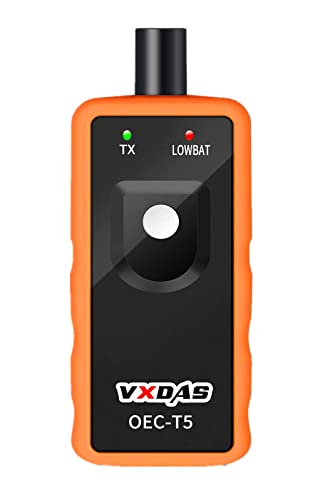
For GM vehicle owners and repair shops seeking efficient tire pressure monitoring, the VXDAS TPMS Relearn Tool (OEC-T5-2025 Edition) stands out as an essential tool. Designed for models from 2006 to 2024, including Chevy, Buick, GMC, and Cadillac, it supports both 315 and 433 MHz sensors. You’ll appreciate its user-friendly operation that quickly activates TPM sensors in just 1-2 minutes. This tool guarantees your vehicle is in TPMS Learn Mode for peak performance. With its sensitive sensor chip and durable design, the VXDAS tool maximizes safety by preventing underinflation, enhancing control on the road.
Best For: GM vehicle owners and repair shops looking for an efficient solution to manage tire pressure monitoring systems from 2006 to 2024.
Pros:
- Quick activation of TPM sensors within 1-2 minutes, saving time and trips to service centers.
- User-friendly design ensures ease of operation, making it accessible for all users.
- Enhanced safety through optimal tire pressure management, preventing underinflation.
Cons:
- Not compatible with heavy trucks having more than four tires or external TPMS systems.
- Limited to GM vehicles, reducing its usability for owners of other brands.
- Requires the vehicle to be in TPMS Learn Mode before use, which may be a limitation for some users.
Autel MaxiTPMS TS508WF TPMS Relearn Tool

Engineers and technicians looking for an efficient way to manage tire pressure monitoring systems will find the Autel MaxiTPMS TS508WF TPMS Relearn Tool an invaluable asset. Weighing just 3.89 pounds and featuring WiFi updates, this tool supports programming and activation of Autel MX-Sensors, easily activating 99% of TPMS sensors. It provides extensive diagnostics, including sensor data retrieval and system health checks. Compatible with a wide range of vehicles, the TS508WF is designed for seamless operation. Plus, you’ll benefit from a one-year quality backup and lifetime technical support, ensuring you’re always equipped to handle your TPMS needs.
Best For: The Autel MaxiTPMS TS508WF TPMS Relearn Tool is best for automotive engineers and technicians seeking an efficient and versatile solution for managing tire pressure monitoring systems.
Pros:
- Extensive Compatibility: Works with a wide range of vehicles, including US, EU, and Asian models.
- User-Friendly Updates: Offers lifetime free WiFi updates, eliminating the need for PC connections.
- Comprehensive Diagnostics: Provides detailed sensor data retrieval and system health checks.
Cons:
- Discontinued Model: This product has been discontinued, which may limit future support and availability.
- Weight: At 3.89 pounds, it may be slightly heavier compared to other portable tools.
- Limited Vehicle Year Range: Compatibility varies by vehicle make, model, and year, requiring VIN verification for some users.
XTOOL TP150 TPMS Programming Tool
When you need a reliable tool for TPMS maintenance, the XTOOL TP150 TPMS Programming Tool stands out as an excellent choice for automotive shops. This versatile tool activates, relearns, and programs sensors while also reading data and diagnosing issues. With support for both 315/433MHz sensors, it covers 99% of vehicles, including popular brands like Ford and Toyota. The TP150 offers four programming modes, ensuring efficient relearning after tire changes. Its user-friendly interface and robust design make it portable and durable for any shop environment. Plus, you’ll benefit from lifetime updates for ideal performance.
Best For: Automotive shops and DIY enthusiasts looking for a reliable and versatile TPMS maintenance tool.
Pros:
- Supports both 315/433MHz sensors, covering 99% of vehicles.
- Four programming modes for efficient sensor relearning and activation.
- User-friendly interface with robust design for portability and durability.
Cons:
- Lacks a touch screen, which may limit interaction options for some users.
- Requires Vehicle Identification Number (VIN) for compatibility checking prior to purchase.
- May not offer advanced features found in higher-end TPMS tools.
Autel MaxiTPMS TS408S TPMS Relearn Tool

The Autel MaxiTPMS TS408S TPMS Relearn Tool is an ideal choice for automotive shops seeking efficiency and cost-effectiveness. This tool simplifies tire pressure monitoring system tasks with features like faster programming, reading sensor data, and various relearn methods. You can program Autel MX-Sensors through OBD or auto-create new sensors for those with low batteries. It’s compatible with over 150 car makes from 1996 to 2026 and provides lifetime free updates. Plus, with a 1-year warranty and 24/7 customer support, you’ll have peace of mind while enjoying its substantial value compared to similar models.
Best For: Automotive shops looking for a cost-effective and efficient TPMS relearn tool.
Pros:
- Offers faster TPMS programming and diagnostic capabilities.
- Compatible with over 150 car makes from 1996 to 2026, ensuring broad usage.
- Includes lifetime free software updates and 24/7 customer support.
Cons:
- Lacks some advanced features found in higher-end models like TS508WIFI.
- Limited to programming Autel MX-Sensors only.
- May require additional training for users unfamiliar with TPMS systems.
Autel MaxiTPMS TS508WF KIT, TPMS Programming Relearn Tool

For automotive shops looking to streamline their tire pressure monitoring system (TPMS) services, the Autel MaxiTPMS TS508WF KIT stands out with its WiFi capabilities and advanced programming features. This tool supports three relearn methods and two MX-sensor programming options, enabling you to activate 99% of sensors while reading real-time data like pressure and temperature. With eight rubber sensors and four metal valve stems included, you’ll enhance your service offerings. The one-click WiFi updates guarantee you stay current with the latest features, and its diagnostic functions help you efficiently manage TPMS codes and warning lights.
Best For: Automotive shops looking to enhance their tire pressure monitoring system (TPMS) services with advanced programming and diagnostic capabilities.
Pros:
- Supports multiple TPMS relearn methods and MX-sensor programming options for versatility.
- Activates 99% of sensors and provides real-time data, improving service efficiency.
- Comes with eight rubber sensors and four metal valve stems, adding value to the kit.
Cons:
- May have a learning curve for users unfamiliar with TPMS programming tools.
- Limited to specific vehicle compatibility, potentially excluding older models.
- Reliance on WiFi for updates may be an issue in areas with poor connectivity.
Factors to Consider When Choosing TPMS Programming Tools for Shops
When you’re choosing TPMS programming tools for your shop, consider factors like compatibility with various vehicle models and the methods for programming and relearning. You’ll also want to evaluate the diagnostic capabilities, software updates, and support to guarantee you’re making a smart investment. Don’t forget about the importance of a user-friendly interface for you and your team.
Compatibility With Vehicle Models
Selecting a TPMS programming tool that suits your shop’s needs hinges on its compatibility with various vehicle models. You’ll want to verify the tool works with a wide range of domestic and international brands, covering both newer and older vehicles. Check if it supports the specific TPMS frequency types—315MHz and 433MHz—used by the vehicles you plan to service. Compatibility across production years is essential, so look for tools that can handle vehicles from 1996 to 2024. Additionally, consider whether the tool can perform multiple relearn methods, like Stationary, Automatic, and OBD relearn. Finally, confirm it offers compatibility verification options, like VIN checks, to avoid any issues with unsupported models.
Programming and Relearning Methods
While you may focus on compatibility when choosing a TPMS programming tool, understanding the programming and relearning methods is equally essential. Look for tools that offer various programming methods like Auto ID Generation, Manual Input ID, and Copy ID via OBD, which help you efficiently program different sensor types. Relearning methods also matter; Stationary Relearn, Automatic Relearn, and OBD Relearn cater to various vehicle makes and models. Choose tools that support multiple sensor activation frequencies, such as 315MHz and 433MHz, to enhance versatility. Tools that activate and relearn sensors right after tire changes boost shop efficiency by minimizing dealer visits. Finally, user-friendly interfaces and clear instructions make the process smoother, especially for less experienced technicians.
Diagnostic Capabilities and Features
Diagnostic capabilities are crucial when choosing TPMS programming tools for your shop. You’ll want tools that can read and clear Diagnostic Trouble Codes (DTCs) for effective troubleshooting of tire pressure monitoring systems. Look for options that retrieve real-time sensor data, including tire pressure, temperature, battery status, and sensor ID, giving you a complete overview of each tire’s condition. Multiple TPMS relearn methods—like Stationary, Automatic, and OBD—provide flexibility across various vehicle models. It’s also imperative that the tool provides detailed diagnostics of system health to identify faulty sensors and reset TPMS warning lights after repairs. Finally, confirm compatibility with a wide range of domestic and international vehicles to meet your shop’s diverse needs.
Software Updates and Support
When it comes to TPMS programming tools, software updates and support play a pivotal role in maintaining your shop’s efficiency and effectiveness. It’s essential to choose tools that offer lifetime free software updates to stay compatible with new vehicle models. Opt for solutions that allow easy online or WiFi updates, as they minimize downtime compared to those needing a PC. Additionally, guarantee the tool provides responsive technical support; quick assistance can save you time and resolve issues efficiently. Regular updates enhance functionality, keeping you up-to-date with the latest TPMS protocols. If your shop serves a diverse clientele, look for tools that support multiple languages in their software updates to cater to all your customers effectively.
User-Friendly Interface and Design
A user-friendly interface can greatly impact the efficiency of TPMS programming tools in your shop. When you choose tools with clear, concise display screens, you get real-time data on tire pressure, sensor IDs, and diagnostic trouble codes, allowing for immediate assessments. Intuitive button layouts simplify the activation and programming processes, enabling you to perform tasks effectively without needing extensive training. Ergonomic designs and lightweight materials enhance portability, making it easier to transport tools between work areas. Plus, multilingual support guarantees all team members can operate the tools confidently. By prioritizing user-friendly design, you not only streamline operations but also boost productivity, making your shop more efficient and effective.