
If you’re looking to enhance your driving experience, OBD2 head-up display monitors might be just what you need. These innovative devices provide real-time insights into your vehicle’s performance, keeping you informed while you drive. From speed to fuel consumption, the data can make a noticeable difference in your overall safety and convenience. Curious about the best options available? Let’s explore the top 10 HUDs that can transform your time on the road.
OBD2 Gauge Display Heads Up Display for Cars
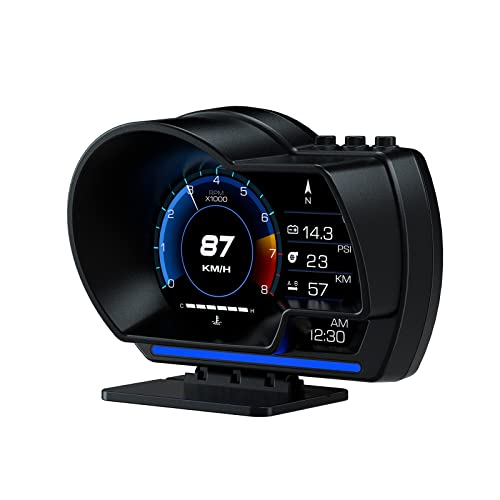
If you’re looking for a way to keep essential driving information right in your line of sight, the OBD2 Gauge Display Heads Up Display (HUD) for cars is an excellent choice. This model P6 combines OBD and GPS functions, showing speed, RPM, water temperature, and overspeed alerts. Designed to minimize distractions, it changes ambient light from blue to red, ensuring you stay informed without taking your eyes off the road. With ten interface options and dual mode operation, you can easily access over 100 types of data. Plus, its non-destructive installation makes it user-friendly for most vehicles.
Best For: Drivers who want to access essential vehicle information without taking their eyes off the road.
Pros:
- Offers dual mode operation (OBD+GPS) providing extensive data if the vehicle supports OBD2 protocol.
- Non-destructive installation options make it easy to set up in most vehicles.
- Ambient light changes color to provide clear alerts for overspeed conditions.
Cons:
- Performance may be limited if the vehicle does not support OBD2.
- Some users might find the installation instructions unclear.
- The display may be difficult to read in direct sunlight for some users.
MH Head Up Display for Car (OBD2+GPS Dual System)

The MH Head Up Display for Car (OBD2+GPS Dual System) is perfect for tech-savvy drivers who want real-time insights into their vehicle’s performance. You’ll enjoy monitoring essential data like speed, fuel consumption, and water temperature, all while easily switching between OBD2 and GPS modes. This display also scans for fault codes, allowing you to diagnose issues swiftly. With customizable alerts for speeding and engine temperature, you can drive confidently. Its compatibility with OBDII vehicles post-2008 makes it a solid choice, while the sleek installation options guarantee it fits seamlessly into your driving experience.
Best For: Tech-savvy drivers looking for real-time vehicle performance insights and fault diagnostics.
Pros:
- Real-time data monitoring provides essential information like speed, fuel consumption, and water temperature.
- Fault diagnosis capability allows quick identification and clearing of vehicle issues.
- Customizable display and alerts ensure drivers can tailor the experience to their preferences.
Cons:
- Limited compatibility with certain vehicle brands and types, excluding diesel, hybrid, and modified cars.
- Requires OBDII compliance, making it unsuitable for older vehicles or those not adhering to this standard.
- Installation may be challenging for some users, depending on their vehicle setup.
Head Up Display Car HUD P8 for Most 2008+ Cars

For drivers of most 2008 and newer cars, the Head Up Display Car HUD P8 stands out with its innovative OBDII and GPS dual system. This model offers a simple installation, fitting seamlessly on your A-Pillar trim or dashboard. In just half a mile, it locks onto satellites to display essential data like speed, RPM, and water temperature. With eight customizable display interfaces, you can tailor your view to your liking. Weighing only 2.56 ounces and measuring 1.18 inches, it’s compact yet powerful. Plus, with reliable customer support and certifications, you can trust its quality and performance.
Best For: Drivers of most 2008 and newer cars looking for a convenient and informative heads-up display for real-time vehicle data.
Pros:
- Dual System: Combines OBDII and GPS for comprehensive vehicle monitoring.
- Customizable Display: Offers eight different interfaces for a personalized viewing experience.
- Easy Installation: Simple setup process that can be completed in minutes.
Cons:
- Compatibility Limitations: May not work with all vehicle models, specifically those older than 2008.
- Satellite Lock Time: Requires half a mile to lock onto satellites before displaying data.
- Size: Some users may find the compact size less noticeable on the dashboard.
OBD2 HUD Head Up Display for Car and Truck

Looking for a way to enhance your driving experience? The OBD2 HUD Head-Up Display is perfect for both cars and trucks, providing you with real-time data like speed, water temperature, and fuel consumption. Its plug-and-play installation means you won’t have to modify your vehicle, making it user-friendly. This digital GPS speedometer guarantees accurate readings, especially beneficial for older models with limited gauges. Plus, it supports fault code reading and clearing, allowing you to troubleshoot issues quickly. With compatibility for OBDII and EOBD protocols, this display is a reliable choice for safer driving, backed by a 2-year warranty and lifetime support.
Best For: Drivers of cars and trucks looking to enhance their dashboard data with real-time performance metrics.
Pros:
- Easy plug-and-play installation without vehicle modifications required.
- Provides a wide range of real-time data including speed, temperature, and fuel consumption.
- Supports fault code reading and clearing for efficient troubleshooting.
Cons:
- Not compatible with older OBDI or specific vehicle brands/models including Dodge, Jeep, and hybrids.
- Limited functionality for vehicles manufactured before 2008.
- May not be suitable for modified ECU systems or diesel vehicles.
OBD2 Speedometer with GPS Dual System for Cars

If you’re a car enthusiast seeking to enhance your driving experience, the OBD2 Speedometer with GPS Dual System is an excellent choice. This device combines OBD2 and GPS functionalities, offering extensive data like speed, water temperature, and fuel consumption. It’s compatible with most 2008+ sedans, while the GPS mode works with all vehicles, guaranteeing flexibility. You’ll enjoy customizable display options and multiple data combinations for a personalized experience. Installation is straightforward, but remember to check compatibility and verify good GPS signal for ideal performance. With this tool, you can drive smarter and safer, keeping track of every vital parameter on the road.
Best For: Car enthusiasts looking to enhance their driving experience with comprehensive vehicle data monitoring.
Pros:
- Offers dual functionality with both OBD2 and GPS systems for extensive data tracking.
- Customizable display options allow for personalization based on user preferences.
- Straightforward installation process makes it easy to set up in most vehicles.
Cons:
- Compatibility limited to most 2008+ sedans; not suitable for certain brands/models.
- GPS mode requires a strong signal, which may be problematic in low-signal areas.
- Unplugging the OBD cable is necessary during long periods of non-use to prevent power drain.
OBD2 Gauges Display Car HUD Head Up Display F8 Plus

The OBD2 Gauges Display Car HUD Head Up Display F8 Plus is perfect for drivers who value both safety and performance. This device merges OBD and GPS functionalities, acting as a digital speedometer that displays essential data like speed, water temperature, and fuel consumption. It’s compatible with gasoline vehicles post-2009, while older models can use GPS mode. With nine customizable displays, you can tailor the interface to your needs. The built-in alarm system enhances safety with alerts for overspeeding and engine faults. Plus, its plug-and-play installation makes it a hassle-free addition to your driving experience.
Best For: Drivers looking for a reliable and multifunctional head-up display that enhances driving safety and performance.
Pros:
- Provides real-time data on speed, fuel consumption, and engine performance.
- Features a customizable interface with nine display options for personalized use.
- Easy plug-and-play installation that automatically syncs with the vehicle.
Cons:
- Limited compatibility with diesel and pre-2009 vehicles, restricting full functionality.
- Some users may find the range of data overwhelming without prior knowledge.
- The device’s visibility may be affected in direct sunlight, depending on positioning.
OBD2 Gauge Display for Cars
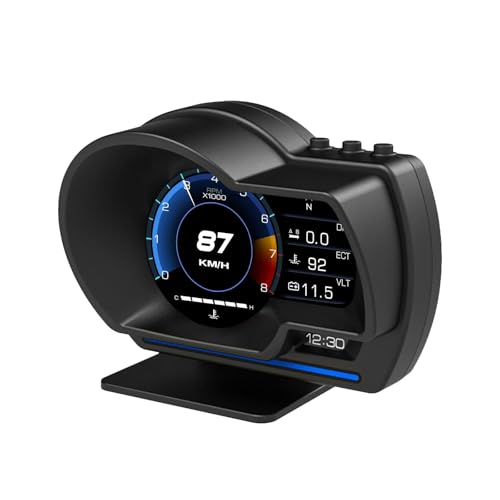
For drivers seeking a blend of modern technology and crucial vehicle metrics, the OBD2 Gauge Display is an excellent choice. This upgraded heads-up display features a dual-mode system (OBD+GPS) that enriches your driving experience. Compatible with gasoline vehicles made after 2009, it shows essential data like vehicle speed, water temperature, and fuel consumption. The display offers customizable screens and multiple installation methods for peak visibility. With safety alarms for overspeed and temperature issues, it guarantees you stay informed about your vehicle’s condition. Built from high-quality materials, this display promises reliability and long-term satisfaction on every drive.
Best For: Drivers of gasoline vehicles manufactured after 2009 who want to enhance their driving experience with real-time data and safety features.
Pros:
- Dual-mode system (OBD+GPS) provides a wealth of vehicle metrics.
- Customizable screens and installation methods ensure optimal visibility.
- Built-in safety alarms enhance driver awareness and vehicle condition monitoring.
Cons:
- Not compatible with diesel vehicles or those manufactured before 2009.
- Limited functionality for pre-2008 gasoline models (only GPS mode available).
- Requires OBD2 compatibility for full feature access.
OBD2 GPS Dual System Car HUD Display

Offering universal compatibility, the OBD2 GPS Dual System Car HUD Display is an ideal choice for drivers seeking an extensive view of their vehicle’s performance. This device presents over 20 critical parameters, including speed, RPM, water temperature, and fuel consumption. With OBD2 mode for post-2008 vehicles and GPS mode for older models, you’re covered. Installation is a breeze with options like a 360° rotating suction cup or adhesive tape. Plus, built-in alerts for overspeed and fatigue enhance your safety. Operating in extreme temperatures, it guarantees reliable performance, keeping you informed and secure on the road.
Best For: Drivers looking for a comprehensive and user-friendly solution to monitor their vehicle’s performance metrics in real-time.
Pros:
- Universal compatibility with both newer and older vehicle models.
- Extensive data monitoring with over 20 parameters for enhanced driving insights.
- Easy installation options including suction cup, console base, and adhesive tape.
Cons:
- Requires OBD2 port for full functionality, limiting use in vehicles manufactured before 2008.
- Potential visibility obstruction if not installed correctly or if it hinders driver sightlines.
- Limited functionality for vehicles without OBD2 compatibility compared to GPS mode.
Heads up Display for Cars (K1-White)

Experience enhanced driving safety with the K1-White Heads Up Display, designed specifically for those who prioritize real-time speed monitoring. Utilizing advanced GPS and BDS technology, it connects to up to 32 satellites for fast, stable, and accurate speed tracking. The large font display shows your speed in MPH, ensuring you stay informed without taking your eyes off the road. With automatic brightness adjustment, it adapts to any lighting condition, providing clear visibility day or night. USB-powered and compatible with most vehicles, the K1-White is your ideal companion for safer, more convenient driving.
Best For: The K1-White Heads Up Display is best for drivers who value real-time speed monitoring and enhanced safety while on the road.
Pros:
- Large font display ensures clear visibility of speed readings, enhancing driving safety.
- Automatic brightness adjustment allows for comfortable viewing in various lighting conditions.
- USB-powered compatibility makes it easy to use with most vehicles without the need for an OBD port.
Cons:
- GPS signal accuracy may be affected in tunnels, underground garages, or during adverse weather conditions.
- Normal deviation in speed readings can range from 0.6 to 1.8 MPH, which may not be sufficient for precise speed tracking in some scenarios.
- Requires a clear satellite reception for optimal performance, limiting effectiveness in certain environments.
M3 Smart OBD2 Heads Up Display for Cars
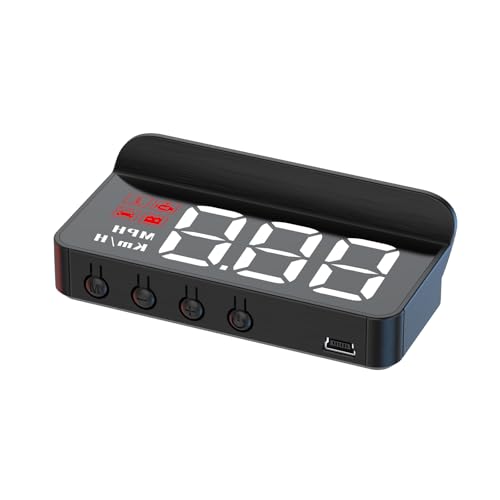
The M3 Smart OBD2 Heads Up Display is ideal for drivers who prioritize safety and real-time vehicle monitoring. It shows key data like speed, coolant temperature, and battery voltage directly on your windshield, letting you keep your eyes on the road. With features that warn against overspeeding and overheating, you’ll drive with confidence. Plus, it connects to your car’s OBD2 port for instant diagnostics, alerting you to engine trouble codes. Customize what you see with adjustable settings, and enjoy its durable design that performs well in all conditions. This display is perfect for daily commutes and adventurous road trips alike.
Best For: The M3 Smart OBD2 Heads Up Display is best for safety-conscious drivers who want to monitor their vehicle’s performance and diagnostics in real-time.
Pros:
- Provides essential driving data on the windshield, enhancing safety and focus on the road.
- Offers customizable display options to suit individual preferences and driving needs.
- Durable design ensures reliable performance in various driving conditions.
Cons:
- Requires access to the car’s OBD2 port, which may not be compatible with very old vehicles.
- Some users may find the installation process challenging without prior experience.
- Limited to the information provided by the vehicle’s OBD2 system, which may not cover all diagnostic needs.
Factors to Consider When Choosing OBD2 Head Up Display Monitors
When choosing an OBD2 head-up display monitor, you should think about several key factors. Display clarity and size, compatibility with your vehicle, and installation methods are essential for a seamless experience. Additionally, consider the data monitoring features and safety alert functions to guarantee you get the most out of your device.
Display Clarity and Size
Choosing an OBD2 head-up display monitor involves considering two key factors: display clarity and size. Display clarity is essential for readability, especially in varying lighting conditions. Look for models with anti-reflective coatings to enhance visibility. The size of the display can notably impact your experience; while larger screens often present clearer information, they can obstruct your line of sight if not placed correctly. Many monitors offer adjustable font sizes and brightness settings to suit your preferences. High-resolution displays deliver sharper images and detailed data, improving usability. A well-designed user interface with customizable options allows you to prioritize important information, making your driving experience more convenient and safe.
Compatibility With Vehicles
Ensuring your OBD2 head-up display monitor is compatible with your vehicle is essential for a seamless experience. Most monitors work with vehicles manufactured after 2008, as they rely on the OBDII protocol. If you own an older model or one with a modified ECU, your options may be limited to GPS mode only. Additionally, certain types of vehicles, like diesel and hybrid electric models, might not support these displays. Before making a purchase, always check the compatibility with your vehicle’s make and model. Some monitors provide lists of incompatible brands, which can help you avoid buying a product that won’t function properly with your vehicle. Doing this simple check saves you time and frustration down the road.
Installation Methods Available
While selecting an OBD2 head-up display monitor, you’ll want to take into account the various installation methods available to guarantee a hassle-free setup. Most monitors provide multiple options, like mounting on the dashboard, A-Pillar trim, or using adhesive tape for windshield placement. Look for displays with adjustable brackets, ensuring ideal positioning without blocking your view. Many models feature plug-and-play installation, connecting easily to the OBD2 port, which is standard in vehicles made after 2008. If you prefer flexibility, consider those with suction cup mounts for easy repositioning and removal. Taking these factors into account will help you choose a monitor that fits your needs and makes installation straightforward.
Data Monitoring Features
After you’ve settled on a suitable installation method for your OBD2 head-up display monitor, it’s time to evaluate the data monitoring features that can enhance your driving experience. Look for real-time metrics like speed, RPM, water temperature, and voltage to better understand your vehicle’s performance. Many displays also provide additional insights, such as fuel consumption, driving distance, and trip time, giving you a thorough view of your vehicle’s status. If you want advanced capabilities, choose models that show diagnostic data and fault codes, allowing you to troubleshoot issues on the spot. Some displays support dual systems, monitoring over 20 parameters like altitude and driving direction. Customizable display modes let you tailor the interface to your driving preferences.
Safety and Alert Functions
When choosing an OBD2 head-up display monitor, it’s essential to take into account the safety and alert functions that can greatly enhance your driving experience. Look for overspeed warnings that alert you when you exceed a pre-set speed limit, promoting safer driving. Temperature alerts are vital too, notifying you if your engine’s coolant temperature rises above safe levels to prevent overheating. Additionally, voltage monitoring can warn you of low battery voltage, helping you avoid breakdowns. Some displays even include fatigue driving alarms to remind you to take breaks on long trips, reducing the risk of drowsiness-related accidents. A color-coded ambient light system that shifts from blue to red during alerts can effectively capture your attention.